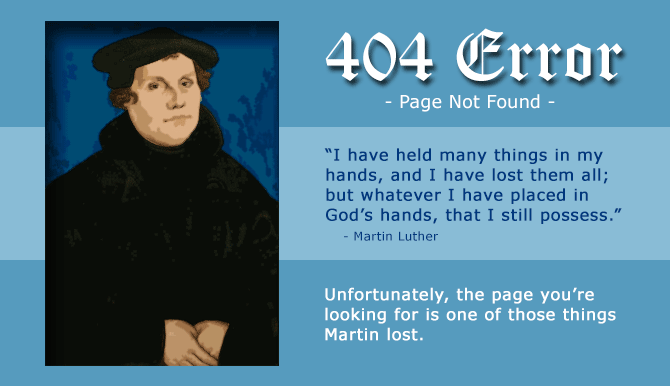
Choirs have a long history of leading worship. Many references to a choir of men and boys singing and playing instruments can be found in the Old Testament. Worship in the early Christian church drew on these models that had become a part of synagogue worship. During the Middle Ages, choirs continued to play an important role in the liturgical practice of the Christian church, particularly with the advent of polyphonic (multi-layered, more complex) music. By the time of the Reformation, singing the liturgy had become the purview of the priests and choirs. The congregation was comprised of passive spectators. Luther returned many parts of the liturgy to the congregation, insisting that they sing, but he never lost sight of the indispensable contribution of the choir. In fact, Luther argued that "'in the cultivation of music at the highest levels of artistic excellence the perfect goodness and wisdom of God are displayed'" and thus "successfully encouraged the reciprocal interaction of art music of the most highly developed kind together with simple congregational song" (Schalk, p. 35).
What do these converging traditions have to say to us today concerning the role of the choir in our liturgies? Obviously, the choir has a variety of responsibilities. Their primary role is to support and enhance the congregation in song. As such, the choir becomes an important leader in worship, guiding the gathered assembly in prayer and praise through song. Rabbi Abraham Joshua Heschel, in his book The Insecurity of Freedom, wrote concerning those charged with leading the synagogue congregation's song:
"The right Hebrew word for cantor is . . . master of prayer. The mission of a cantor is to lead in prayer. He does not stand before the Ark as an artist in isolation, trying to demonstrate his skill or to display vocal feats. He stands before the Ark not as an individual but with a congregation. He must identify himself with the congregation. His task is to represent as well as to inspire a community. Within the synagogue music is not an end in itself but a means of religious experience. Its function is to help us to live through a moment of confrontation with the presence of God: to expose ourselves to him in praise, in self-scrutiny and in hope." (Parker, p. 80)
This characterization of the cantor certainly applies to the choir as well. The choir is that portion of the congregation that is trained and rehearsed for the specific task of leading the sung prayer and praise of the people. Choir leaders will want to help the whole congregation to develop a clear understanding of the choir's role in the liturgy and its importance for the worship life of those assembled. In order to fulfill this calling, all choirs, no matter how large or small, no matter how limited or great their skill, will strive for excellence in all that they do.
We will want to avoid confusing excellence that seeks self-aggrandizement, with artistic excellence through which God is offered highest praise and God's grace is revealed to those gathered. Each of us, whether a worshiper in the pew or a choir member, will want to offer to God the best we can as our sacrifice of praise to God (Heb. 13:15). We should not be afraid of excellence. Rather, we should rejoice in it. How many of us, however, have been at a worship service where there was little care for detail, where the musical portions of the liturgy were ill-prepared and poorly executed? Instead of being absorbed in worship and sensing the importance of worship, our attention shifted to the difficulties of those trying to lead. Without exception, choirs want to be well prepared and to sing well. It is equally important that choristers understand that they are singing for worship, not for entertainment.
Does that mean that our choirs need to be filled with professional singers? Absolutely not! Any choir can sing well, provided the music is appropriate to their skill level and they are well-trained and rehearsed. Music that is simple and well taught provides choirs with a means to get beyond the mechanics and give heartfelt expression to the text. This music, in turn, can provide the whole assembly with a means truly to encounter God in its worship.
To this end, choirs must thoroughly rehearse the canticles and hymns to be sung in the liturgy, so that they can lead with confidence. The choir may even be called upon to act as teacher, to help the assembly learn new hymnody and musical settings of the liturgy; if the congregation is to learn new music quickly and accurately, the people must have enthusiastic and competent leadership. The choir needs to spend adequate time learning new liturgical music well and in the proper style so that it can communicate not only the correct melodies and rhythms, but also a sense of the music's mood and style in such a way that the music is infectious and compels those in the congregation to sing with choir. Above all, the well-rehearsed choir will breathe life into the text as it sings with clear understanding and insight into the words and their meaning. The texts can shape the faith of those who worship.
Attendant music, such as anthems and motets, should also be well-rehearsed and must be of the highest quality, whatever the musical style. Their use should enhance the liturgy as both praise and proclamation, and contribute to that wonderful interaction between more complex art music and simpler congregational melodies.
Many congregations are blessed with excellent choirs, and in addition to leading Sunday worship, these choirs may be encouraged to present a concert of sacred music or a choral evening prayer once or twice a year . These events give the choir a chance to prepare an extended work that may not be suited to the Sunday morning liturgy but that contributes to the spiritual growth of the congregation. The gifts and leadership of the choir should be shared with the whole congregation as often and in as many ways as possible.
In most congregations, choirs are made up of volunteers from the parish that view their choir membership as stewardship of their talents and time. In fact, most choristers are very committed to their leadership role, often rehearsing for several hours each week, as well as being present for worship each Sunday. Several other models of choral participation are increasingly in use in our parishes, due in most part to the hectic lifestyles we lead. Some singers commit to sing in the choir for a particular season, resulting in varying groups of people serving as the choir throughout the year. Some congregations have a festival choir that enables singers who cannot make a long-term commitment to rehearse for five or six weeks, preparing for a festival service or season when a larger choir is needed or desired. In congregations with two Sunday liturgies, some choirs divide in half, each singing one liturgy. On festival days, the entire choir sings at both. Some congregations have a choir for children. Others have intergenerational choirs or combine adult and children's choir on occasion. Children certainly can provide musical leadership for worship. Creative choir programs that fit a local situation can be rewarding both to the choir member and the worshipers they lead.
May anyone sing in the choir? Making music in a choir is a corporate endeavor; each singer must be able to contribute to the whole. Music directors should not feel uncomfortable about carefully guiding would-be choir members who have no innate musical skills into other avenues of service or leadership.
Our choirs can provide indispensable leadership for worship if we encourage them and adequately equip them for the task. Choirs that are enthusiastic, understand their role, and approach their task with a sense of reverence will, in turn, lead others to a profound conviction that through the music of the liturgy, we encounter the Holy God.
Resources
- Bertalot, John. John Bertalot's Immediately Practical Tips for Choral Directors. Minneapolis: Augsburg Fortress, 1994.
- Buckley Farlee, Robert. Musicians in the Assembly. Minneapolis: Augsburg Fortress, 2001. One of the first publications in the new Worship Handbook series. This small booklet is intended as a primer for all who serve as leaders of church music in congregations. ISBN: 0806642793.
- Parker, Alice. Melodious Accord. Chicago: Liturgy Training Publications, 1991.
- Schalk, Carl. Luther on Music. St. Louis: Concordia Publishing House, 1988.
- Sundays and Seasons: Worship Planning Guide. Minneapolis: Augsburg Fortress, published annually.
- Wilson-Dickson, Andrew. The Story of Christian Music. Philadelphia: Fortress Press, 1996.