Germany

Evangelical Lutheran Churches of Germany

 
American Church
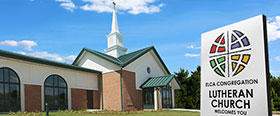
The American Church in Berlin: Located in an impoverished area of former East Berlin, the church ministers to many different populations, including Muslims
Who are the ELCA companions in Germany?
Who is the Evangelical Church in Germany and what are its ministries?

Twenty-two Lutheran, Reformed and United regional churches (Landeskirchen) form the Evangelical Church in Germany (Evangelische Kirche in Deutschland - EKD). German Protestant church structures are based on federal principles at all levels. Each local congregation is responsible for Christian life in its own area, while each regional church has its own special characteristics and retains its independence. Without in any way diminishing this autonomy, the EKD carries out joint tasks with which its members have entrusted it.

Who is the United Evangelical Lutheran Church of Germany and what are its ministries?

The United Evangelical Lutheran Church of Germany, the Vereinigte Evangelisch-Lutherische Kirche Deutschlands (VELKD) includes almost 11 million people in the unification of eight Lutheran churches into one church body:  the Evangelical Lutheran Church in Bavaria, the Evangelical Lutheran Church in Brunswick, the Evangelical Lutheran Land Church Hanover, the Evangelical Lutheran Church of Mecklenburg, the North Elbian Evangelical Lutheran Church, the Evangelical Lutheran Church of Saxony, the Evangelical Lutheran Church Schaumburg-Lippe, and the Evangelical Church of Middle Germany (a merger that includes the former Evangelical Lutheran Church in Thuringia).   VELKD formed in July of 1948 in Eisenach, Germany, and now represents the Lutheran part of the Evangelical Church in Germany.  

Each of VELKD’s member churches maintains its respective ministry while also being part of VELKD’s ministry programs. VELKD identifies five areas of “endeavor:” theology, parish work, worldwide Lutheranism, ecumenism, and law-making and courts. Each of these areas supports the local congregations and further unites the VELKD.

Who is the Evangelical Lutheran Church in Bavaria and what are its ministries?

Bishop Hanson
Bishop Hanson visits Germany
The Evangelical Lutheran Church in Bavaria (ELCB) , a member of the Lutheran World Federation (LWF), comprises over 1500 parishes with a total of more than 2.7 million members in this region of Southern Germany. About 23 percent of Bavaria's population is Lutheran, and about 60 percent of Bavaria's Lutherans reside in the northern part, Franconia, in rural villages as well in the Nuremburg and other urban areas. Bavarian Lutheranism has also spread out to cities like Munich and Augsburg. This combination of being at once concentrated and deployed has given the ELCB its characteristic concern for confessional unity near and far.

Worship in Bavarian Lutheran churches has long valued the liturgy and hymns as integral to preaching the Word and administering the sacraments. In education, a strong accent remains on confirmation instruction, religious education in the public schools, and work among young people. The practice of a diaconal year of service by young women was introduced in the 1950s.

Most of the pastors are educated in the two Bavarian university faculties of theology, Erlangen and Munich, and in the church's Augustana Hochschule in Neuendettelsau. The church maintains other teaching institutions for training deacons and deaconesses and other church workers. The church's Department of World Mission is one of many companions with the ELCA in global mission.

Who is the Evangelical Lutheran Church of Mecklenburg and what are its ministries?

The Evangelical Lutheran Church of Mecklenburg, a member of the Lutheran World Federation (LWF), consists of 245,000 members in about 350 parishes. Mecklenburg was the last of the north German areas to be Christianized. But already in 1419, the University of Rostock was founded, the first institution of higher learning for northern German and the Scandinavian countries. By 1557, the introduction of the Reformation was complete.

Following devastation from the Thirty Years' War (1618-1648), the spiritual forces of Pietism found a welcome among the people of eastern Mecklenburg and motivated the process of reconstruction and development. In spite of the influences of the Enlightenment (Rationalism), a strong movement of religious awakening led to a strengthening of confessional Lutheranism. The leader in this movement was theologian and churchman Theodor Kliefoth (1810-1895). Strong confessionalism provided a firm base for the Lutheran church in the region, leading to the modern church.

The Evangelical Lutheran Church of Mecklenburg went through a period of intense church conflict between 1933 and 1945. Former bishop and church historian Niklot Beste's account of this conflict, published in 1975, shows the struggle of a church in maintaining its task in a changing world. After World War II many people left for the West and church membership declined. But the sturdiness in matters of faith, developed during the 1930s by those in the Confessing Church, enabled many members of the Mecklenburg Church to remain faithful during the communist era.

The Baltic coast shows evidence of the ELCM's ministries, especially in the industrialized port cities of Wismar and Rostock. Here a new parish was developed on the outskirts of Rostock -- a venture which was undertaken in close partnership with the Roman Catholic minority. The church building itself is a very old one, dating from the 14th century. But the interior has been renovated, and it invites people from a modern industrial society to explore the resources of a faith that is centuries old.

Who is Evangelical Lutheran Church of Saxony and what are its ministries?

The Evangelical Lutheran Church of Saxony (ELCS), is a member of the Lutheran World Federation (LWF).  Its boundaries correspond to those of the former kingdom of Saxony after 1815. The region was at the forefront of the Reformation movement when Elector Frederick III (1463-1525), who had founded the University of Wittenberg, became Martin Luther's protector. Luther conducted the first Evangelical worship service in Leipzig.

The ELCS sees itself as a community of fellow-workers in which the priesthood of all believers assumes contemporary form. Practical service (diakonia) in various institutions and agencies linked to the church continues to have a very important place. The musical heritage of Saxony's Lutheranism has become world famous through Johann Sebastian Bach, organist and cantor at St. Thomas Church, Leipzig, and through Heinrich Schütz in Dresden.

The ELCS identifies several area of ministry activity: ecumenism, education, church development, mission, art and culture, work and profession, and church social service. In each of these areas are many programs and activities making up the ministry of the ELCS.

Who is the Evangelical Church of Middle Germany and what are its ministries?

Protestant churches in the federal states of Saxony-Anhalt and Thuringia have merged into the Evangelical Church of Middle Germany.  It has 900,000 in over 3,000 parishes. It consists of 38 administrative districts. The EKM is in the process of applying to be member of the LWF and VELKD.

Castle Church
Spire of the Castle Church in Lutherstadt Wittenberg, where Martin Luther is said to have nailed his 95 Theses in 1517
The Evangelical Lutheran Church in Thuringia, one of the predecessor bodies that was in a companion relationship with the ELCA, arose from Luther's Reformation, and the picturesque province of Thuringia was part of the Reformation from its beginning. Eisenach is Martin Luther's childhood home, and Luther House is now a museum recalling Luther's boyhood days. Overlooking the city is the Wartburg, where Luther translated the New Testament (1521-1522). In nearby Weimar, the standard critical edition of Luther's works now totaling over 100 volumes has been published over the years since 1883.

Many important events have taken place in Eisenach. One of the most far-reaching was in 1923, when the Lutheran World Convention was founded. It was the forerunner of the present Lutheran World Federation.

The Evangelical Lutheran Church in Thuringia operates many service institutions. The two largest are Sophia Hospital in Weimar and the Deaconess Hospital in Eisenach. Both are affiliated with training centers for nurses. The ELCT, along with other members of VELKD, offer youth ministry programs. Every couple years, a church conference held in Erfurt draws thousands of youth participants. Furthermore, a provincial youth Sunday is held in Eisenach every couple years and as many as 10,000 youth have attended.

How do the companions in Germany and the ELCA accompany one another?

Through the churchwide ELCA Global Mission unit, the ELCA relates to and is in bilateral relationship with over 80 companion churches and institutions. The ELCA Global Mission unit stewards church-to-church relationships with these companions.  .

These relationships are deepened and extended by these relationships through the ELCA Companion Synods program:

  • The Upper Susquehanna Synod and the Southeastern Synod are companions with the Evangelical Lutheran Church in Bavaria.
  • The Southern Ohio synod is a companion with the Evangelical Lutheran Church in Mecklenburg.
  • The Northeastern Pennsylvania synod and the Minneapolis Synod are companions with the Evangelical Lutheran Church of Saxony.
  • The Northwestern Pennsylvania synod is a companion with the Evangelical Church of Middle Germany, which includes their former companion, the Evangelical Lutheran Church in Thuringia.

ELCA Global Mission provides the pastor for the American Church in Berlin and takes turns providing a pastor for Trinity Lutheran Church in Frankfurt.  Global Mission also provides directors for the ELCA Wittenberg Center for Continuing Education in Lutherstadt Wittenberg.

Germany: the context in which our companions serve

Following World War II, Germany was divided in two with East Germany under the control of the Soviet Union. Non-violent reunification took place in 1990. Germany is a federal republic. Over 83 million people live in Germany and German is the official language. The population practices the following religions: Protestant (38%); Roman Catholic (34%); and Muslim (4%).

Germany’s economy is the leading industrial economy in Western Europe. It is the biggest net contributor to the European Union budget. It ranks second in the world in international trade and fourth in economic output. Its strong base in some traditional industries such as heavy goods, autos, and chemical products is now being supplemented by high-tech development. In 2001, Germany became the world’s leading producer of wind power. The cuts to services that may be needed to address the tax-revenue shortfall are of concern, particularly as they are anticipated to be a portion of the cause for an almost doubling of the population living in poverty. Environmental concerns include air and water pollution, acid rain, and the disposal of nuclear and hazardous wastes.

For up-to-date information on Germany, type “Germany” into an online search engine or visit: