Brazil
Evangelical Church of the Lutheran Confession in Brazil
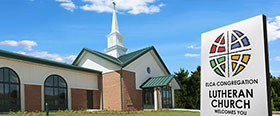
A Lutheran church in rural Brazil
Who is the Evangelical Church of the Lutheran Confession in Brazil and what are its ministries?
The& Evangelical Church of the Lutheran Confession in Brazil
(Igreja Evangelica de Confissao Luterana no Brasil - IECLB), a member of the
Lutheran World Federation, has 716,911 members and is the largest Lutheran church in South America. IECLB membership was once predominantly rural but has increasingly been drawn to the bigger cities. Its primary ministries are mission, service, education, communication and interchurch and ecumenical relations. The formation of new congregations has been on the increase in recent years. There are 18 synods, 489 parishes with 1,800 congregations and 1,115 preaching points. The church has 912 active church workers (293 women) as pastors, catechists, deaconal workers and missionaries; 705 of these church workers are pastors (563 men and 142 women). The IELCB's mission focuses on service to the excluded members of society.
A diaconal project by the Lutheran Church in Brazil near Redife that partners with ecumenical partners to work with Afro-Brazilian youth in the recovery of their cultural heritage
Unlike most other Protestant churches in Latin America, the IECLB is an immigrant church brought by the German immigrants in the 19
th century, starting in 1824. Even today the vast majority of its members claim German cultural roots, but as the church becomes more urban this is starting to change.
The
Escola Superior de Teologia (EST) in Sao Leopoldo is the IECLB's main center for theological education. As well as the basic bacehlor's degree it offers master's level and doctoral degrees in theology and trains lay leaders for congregations, catechists and parochial school teachers, and church musicians and music teachers.
Ecumenical dialogue and relations are an important part of the work of the IECLB. The National Council of Christian Churches in Brazil is working to alleviate suffering and to build a solid basis for a democratic society. Pastoral programs are trying to address the concern about migration.
The IECLB provides missionary outreach programs in Northern Brazil and in urban areas, as well as diaconic services with landless people, small farmers, indigenous peoples, street children and others. One office, Mission Council among Indigenes (Comin), provides pastoral accompaniment and legal advice, and also advocates for indigenous people seeking to claim their rights for land in Brazil. It also works with issues related to the militarization of indigenous territories.
How do the Evangelical Church of the Lutheran Confession in Brazil and the Evangelical Church in America accompany one another in ministry?
Through the churchwide ELCA Global Mission unit, the ELCA relates to and is in bilateral relationship with over 80 companion churches and institutions. The ELCA Global Mission unit stewards relationships with the Evangelical Church of the Lutheran Confession in Brazil.
This relationship is deepened and extended by the relationships, through the ELCA Companion Synods program, between the ELCA Southern Ohio Synod and the IECLB Sínodo Espírito Santo e Belém, and the ELCA Northwest Synod of Wisconsin and the IECLB Sínodo Centro-Campanha Sul.
Churchwide funding through the ELCA Global Mission unit supports key priorities identified by the IECLB, including grants for evangelism and outreach to develop mission work in new areas, evangelism and ministry grants for the Rivera congregation in the border city of Uruguay, a leadership development grant and ELCA mission personnel for the seminary. Ministry grants for Africa enable the IECLB to do mission work in Mozambique and Angola, Portuguese-speaking countries. An "identidade
" grant enables the seminary to work with race issues from the faith perspective and support small farms of former African slaves in Quilombolas. Through World Hunger funds, the ELCA supports the Reconciliation Community Program, "Reconciliação", which serves a great number of children and youth who spend most of their time in the streets. It began its work in 1986 in a region south of Sao Paulo where immigrants from northeast Brazil have settled.
In addition, ELCA funds support Church World Service (CWS) in Brazil. Supported by 36 denominations, including the ELCA, CWS is a U.S.-based ecumenical organization that works with partners to eradicate hunger and poverty and to promote peace and justice around the world.
Worship at a Lutheran church in Sao Paulo
A large favela (slum) in Rio de Janeiro, Brazil
Brazil: The context in which the IECLB serves
Brazil is a federative republic that gained its independence from Portugal on September 7, 1822. About 186 million people live in Brazil and it is ethnically 55% white and 38% black or mixed race. Portuguese is the official language while some Brazilians also speak Spanish, French and/or English. Nominal Roman Catholics make up the largest religious group at 70%.
The biggest challenge facing Brazil is the need for agrarian reform to avoid continuing migration from the country to the cities. Luiz Inacio “Lula” da Silva’s platform called for sustainable macroeconomic growth and the reduction of poverty and inequality. He has adhered to classical economic approaches — controlling spending by trimming the public work force. Brazil has prospered from it membership in Mercosur, a regional trade organization. The trend is toward more trade with the EU and China. However, with the loss of 4.3 million jobs over the last 10 years, poverty remains a challenge. Class, rather than race distinctions, limits the upward mobility of Brazil’s poorer and frequently black population (blacks currently earn 40% less that whites in the same profession).
The burning of the Amazon forests and the decimation of the Indians of Brazil are of concern. Closing the gap between rich and poor remains a problem, as does violence by the police and other groups against street children, indigenous peoples, homosexuals and common criminals.
For up-to-date information on Brazil, type “Brazil” into an online search engine or visit: