Submit your search

How do we use a sanctuary lamp and where do we keep sacramental elements?

 
Some Lutheran church sanctuaries (the area around the altar) feature so-called sanctuary lamps or eternal flames. These devices are usually suspended from the ceiling by a chain over the altar area. Another variant is to have a lamp attached to the sanctuary wall behind or on either side of the altar.

The history surrounding such devices is difficult to determine. Often the origins are linked to references in the Old Testament. God gave directions for the building of the tabernacle that included a lamp stand (Exodus 25:31-40) and told the Israelites to have oil burning lamps in the meeting tent "from evening to morning" as a perpetual ordinance (Exodus 27:20-21).

Modern sanctuary lamps used in Christian worship spaces are linked more directly to the Roman Catholic practice (beginning in the 12th century) of burning a light in front of the reserved sacrament (consecrated bread and wine left after a communion service), to signify and honor the presence of Christ in the elements of bread and wine. In Roman Catholic usage the light near the reserved sacrament is enclosed in red glass and is placed near the tabernacle (a box traditionally recessed into the wall behind or to the side of the altar to house the reserved sacrament).

In some non-Roman churches, primarily Episcopal and a small number of Lutheran churches, a clear glass lamp is kept lighted (in a similar manner to Roman Catholic practice) near an aumbry (a box attached to the wall on one side of the altar to house the reserved sacrament).

Some Protestant churches imitated the Roman Catholic practice by including lamps in their worship spaces but without maintaining tabernacles or the reserved sacrament. Lights in most Protestant churches are housed in a red glass casing. The reason usually given for their presence in the worship space is to signify the eternal presence of God in the church.

Current Roman Catholic building design philosophy does not recommend the presence of sanctuary lamps, whether red for general usage or clear for the reserved sacrament in the worship space. This design theology affirms that the primary purpose of the worship space is for the assembly of God’s people around Word and Sacrament, not for contemplation of the reserved sacrament. Thus new Roman Catholic buildings often place tabernacles in separate chapels or other quarters of the church more appropriate to reservation.

Guidelines for Lutheran Usage


It is not recommended to include eternal flame lamps in the worship space. The rationale about the perpetual presence of God in the sanctuary is theologically weak. It may give worshipers the dubious notion that God is present in worship due to the presence of a light, or that God is on hiatus if for some reason the light is accidentally extinguished!

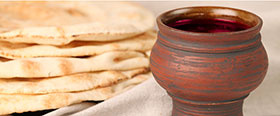
Some Lutheran congregations keep sacramental bread and wine on a credence table or a shelf to be distributed to the sick and homebound. A small number of Lutheran congregations have an aumbry attached to the wall on one side of the altar. Some maintain the practice of placing a clear encased light near the eucharistic elements.

There is no official Lutheran position on the practice of placing a clear encased light near the sacramental elements intended for distribution to the sick and homebound. Lutheran theology does affirm the real presence of Christ in the sacrament. Lutheran theology does affirm the practice of keeping sacramental elements to commune the sick and homebound. Lutheran congregations that decide to maintain a clear encased light near the elements do so to honor or mark the area where the sacramental elements are kept, not to "worship" the elements.

Reserving Eucharistic Elements

It is recommended that Lutheran congregations that keep the sacramental elements for distribution to the sick and homebound consider placing the credence table, shelf or aumbry that houses the elements in a space other than the sanctuary.

Current Lutheran design philosophy, like that of the Roman Catholics, affirms that the worship space is for the gathering of God’s people around Word and Sacrament. The primary symbols in the worship space are the altar, the ambo (lectern/pulpit), the baptismal pool/font (with paschal candle), and the people gathered themselves. Other symbolic furniture, including aumbry or shelves for the sacrament (with or without accompanying lights) are best placed in a separate chapel or the sacristy. A "sanctuary lamp" not in proximity to Eucharistic elements serves no purpose and is confusing ecumenically.

© Evangelical Lutheran Church in America | 800-638-3522