Submit your search

On distribution of Holy Communion

 
The Eucharist or Holy Communion is above all a meal. And it is not mere bread and wine. We actually eat the Lord’s body, and we drink the Lord’s blood. It is an eschatological feast, that is, a foretaste of the heavenly banquet. These facts shape how the elements are distributed. There are several possible modes of distribution. All of them assume that the elements are always handled with reverence and dignity, for they are the living Christ (Apology of the Augsburg Confession, article XXIV). Lutherans call the elements the means of grace, for through the eating and drinking we receive nothing less than the absolute presence of Jesus Christ. And we become what we eat, little Christs.

The most basic question to ask of any method of distribution is how well it responds to Christ’s command to "take and eat" and to "drink from this, all of you...." At Christ’s Last Supper, it is likely that he took a piece of bread, blessed the bread by giving thanks to God (as we do in the eucharistic prayer), broke the bread and gave it to his disciples as they were together at table. It is also likely that he took a cup of wine, blessed it by giving thanks to God, and gave it for the disciples to share by drinking from the cup.

Bread
Today there are several methods of distribution. Traditionally, the bread is distributed by a ordained pastor (usually the presiding minister), and the chalice that holds the wine is borne by a lay assisting minister.

Some congregations use a whole loaf of leavened bread, or unleavened bread such as a pita, from which small pieces are broken off for each communicant. (It is important that the pieces not be too large, as they need to be chewed before receiving the wine. It is helpful if the chalice bearer is a reasonable distance away from the bread bearer, to give adequate time for chewing.) If a whole loaf is used, it is important to prevent crumbs from falling to the floor -- and a simple way to do that is for the presider to hold the loaf or the pita in a purificator (a white linen approximately 12-15 inches square). Other congregations use hosts, which are small thin wafers made simply of wheat and water. The piece of bread or the host is placed by the presiding minister into each communicant’s hand. Either type of bread is acceptable, but the whole loaf is "real" bread, while the hosts do not convey the sense of eating bread.

"The use of leavened bread is the most ancient attested practice of the Church, and gives witness to the connection between the Eucharist and ordinary life. Unleavened bread underscores the Passover themes which are present in the biblical accounts of the Last Supper." (The Use of the Means of Grace (The ELCA’s official statement on sacramental practices), 44B.

There is an ancient tradition (from the fourth century) for communicants to make their hands into a "throne" for the King of kings. This "throne" is made by placing the open right hand upon and across the open left hand (forming a cross). Both hands are then used to bring the bread to the mouth.

Wine
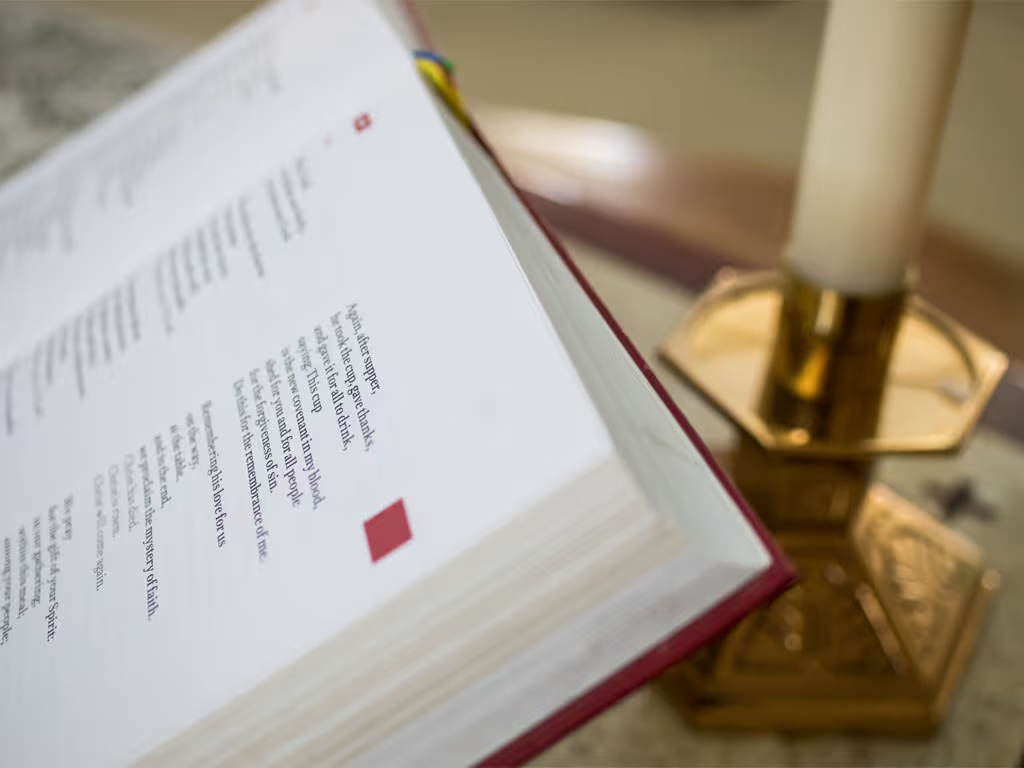
The wine in the Eucharist is normally distributed from a stemmed cup (chalice) from which each person can drink; this is referred to as the "common cup." The act of actually drinking is what Christ commanded. There is a profound theology of the entire assembly drinking from one (or more if the congregation is large) common cup. It conveys the communal nature of the sacrament, and of the Christian life, by virtue of our Baptism. We who are baptized are all one in Christ. This applies also to eating from one loaf, rather than using individual wafers. When using the common cup, the chalice bearers should be instructed about how to wipe the rim inside and out after each communicant with a purificator. Studies have not shown any hygiene problem with the chalice, although it is common courtesy for communicants who have colds or other contagious maladies either to intinct (see below) or to receive only the bread. A silver chalice seems to be the best for hygiene.

Some congregations have a chalice with a pouring lip, so that communicants may take a small empty glass and have the chalice bearer pour wine into it. This, again, puts somewhat less emphasis on the commonality and community of drinking from one chalice. However, it does fulfill Christ’s command to "drink."

Another method, intinction, is dipping the bread into the chalice. This is less desirable because it is not actual drinking. However, if intinction is used, it is preferable to use to use hosts rather than actual bread, in order to preclude crumbs from falling into the chalice, which is not pleasing for the communicants who follow. Problems of this sort can be avoided by having separate chalices for intinction.

Another method involves handing out individual pre-filled glasses. However, this eliminates the sense of commonality and community. As well, if clean cotton gloves are not used by the altar guild when putting the glasses into the tray, there can be a hygiene problem. Studies have shown that there can actually be more of a hygiene problem with the individual glasses than with the common cup. Additional studies have demonstrated that the worst hygiene problem is with the hands of the ministers and the altar guild. For many years (and still in some places now) ministers washed their hands just before the distribution, a practice still to be commended.

The unfortunate recent innovation of disposable plastic cups is convenient, but it is sadly ironic that after years of environmentalists pleading not to use disposable plastic or foam coffee cups, that congregations should embrace this innovation for Communion. This innovation carries all the concerns of "discarding" sacramental wine left in each cup, as well as further enacting our "throw away" culture. More importantly, the question of whether they are worthy to hold the Blood of Christ must be asked.

Other Considerations
Communicants may stand or kneel to receive the bread and wine. In many congregations the ministers stand at the center front of the aisle, so that there can be continuous communion. The ancient practice was to receive by standing. In the present time, in some congregations, communicants kneel during Lent and/or Holy Week, but stand during the remainder of the year. Certainly they should stand during the Easter season, enacting the season of Christ’s Resurrection.

Disabled or infirm persons may sit in the front pew, where the ministers may take Communion to them at the beginning of the distribution. They are as much members of the sacramental community as anyone else.

The sign of the cross may be made by communicants before receiving the bread and after receiving the wine. This ritual action recalls and proclaims Christ’s death on the cross and our union with him through Baptism and Eucharist.

The distribution may be accompanied by music or by silence.

Resources

© Evangelical Lutheran Church in America | 800-638-3522