


Welcome to the ELCA
We are a church that is deeply rooted in tradition and always being made new. We strive to be faithful to the gospel and to work toward more justice and wholeness in the world.
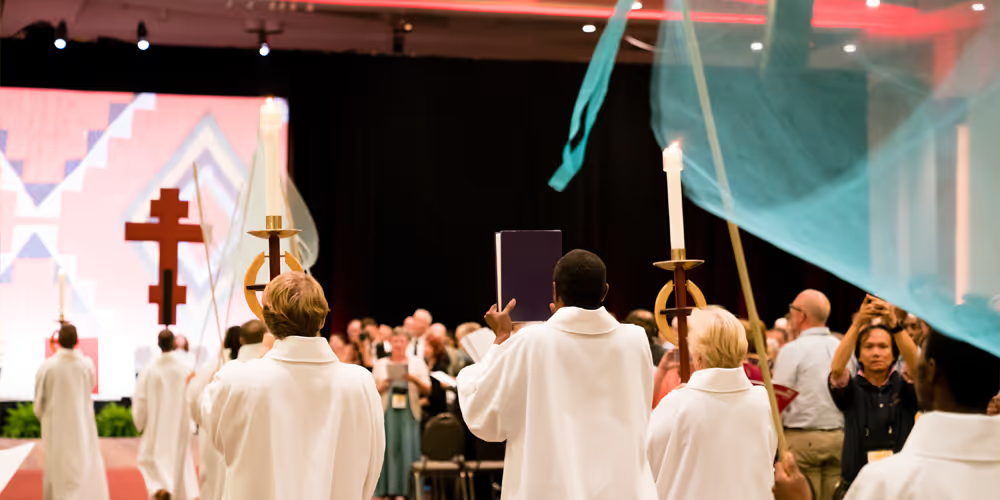

John 18:1—19:42
Good Friday
18:1 After Jesus had spoken these words, he went out with his disciples across the Kidron Valley to a place where there was a garden, which he and his disciples entered. 2 Now Judas, who betrayed him, also knew the place because Jesus often met there with his disciples. 3 So Judas brought a detachment of soldiers together with police from the chief priests and the Pharisees, and they came there with lanterns and torches and weapons. 4 Then Jesus, knowing all that was to happen to him, came forward and asked them, “Whom are you looking for?” 5 They answered, “Jesus of Nazareth.” Jesus replied, “I am he.” Judas, who betrayed him, was standing with them. 6 When Jesus said to them, “I am he,” they stepped back and fell to the ground. 7 Again he asked them, “Whom are you looking for?” And they said, “Jesus of Nazareth.” 8 Jesus answered, “I told you that I am he. So if you are looking for me, let these people go.” 9 This was to fulfill the word that he had spoken, “I did not lose a single one of those whom you gave me.” 10 Then Simon Peter, who had a sword, drew it, struck the high priest’s slave, and cut off his right ear. The slave’s name was Malchus. 11 Jesus said to Peter, “Put your sword back into its sheath. Am I not to drink the cup that the Father has given me?”
12 So the soldiers, their officer, and the Jewish police arrested Jesus and bound him. 13 First they took him to Annas, who was the father-in-law of Caiaphas, the high priest that year. 14 Caiaphas was the one who had advised the Jews that it was better to have one person die for the people.
15 Simon Peter and another disciple followed Jesus. Since that disciple was known to the high priest, he went with Jesus into the courtyard of the high priest, 16 but Peter was standing outside at the gate. So the other disciple, who was known to the high priest, went out, spoke to the woman who guarded the gate, and brought Peter in. 17 The woman said to Peter, “You are not also one of this man’s disciples, are you?” He said, “I am not.” 18 Now the slaves and the police had made a charcoal fire because it was cold, and they were standing around it and warming themselves. Peter also was standing with them and warming himself.
19 Then the high priest questioned Jesus about his disciples and about his teaching. 20 Jesus answered, “I have spoken openly to the world; I have always taught in synagogues and in the temple, where all the Jews come together. I have said nothing in secret. 21 Why do you ask me? Ask those who heard what I said to them; they know what I said.” 22 When he had said this, one of the police standing nearby struck Jesus on the face, saying, “Is that how you answer the high priest?” 23 Jesus answered, “If I have spoken wrongly, testify to the wrong. But if I have spoken rightly, why do you strike me?” 24 Then Annas sent him bound to Caiaphas the high priest.
25 Now Simon Peter was standing and warming himself. They asked him, “You are not also one of his disciples, are you?” He denied it and said, “I am not.” 26 One of the slaves of the high priest, a relative of the man whose ear Peter had cut off, asked, “Did I not see you in the garden with him?” 27 Again Peter denied it, and at that moment the cock crowed.
28 Then they took Jesus from Caiaphas to Pilate’s headquarters. It was early in the morning. They themselves did not enter the headquarters, so as to avoid ritual defilement and to be able to eat the Passover. 29 So Pilate went out to them and said, “What accusation do you bring against this man?” 30 They answered, “If this man were not a criminal, we would not have handed him over to you.” 31 Pilate said to them, “Take him yourselves and judge him according to your law.” The Jews replied, “We are not permitted to put anyone to death.” 32 (This was to fulfill what Jesus had said when he indicated the kind of death he was to die.)
33 Then Pilate entered the headquarters again, summoned Jesus, and asked him, “Are you the King of the Jews?” 34 Jesus answered, “Do you ask this on your own, or did others tell you about me?” 35 Pilate replied, “I am not a Jew, am I? Your own nation and the chief priests have handed you over to me. What have you done?” 36 Jesus answered, “My kingdom does not belong to this world. If my kingdom belonged to this world, my followers would be fighting to keep me from being handed over to the Jews. But as it is, my kingdom is not from here.” 37 Pilate asked him, “So you are a king?” Jesus answered, “You say that I am a king. For this I was born, and for this I came into the world, to testify to the truth. Everyone who belongs to the truth listens to my voice.” 38 Pilate asked him, “What is truth?”
After he had said this, he went out to the Jews again and told them, “I find no case against him. 39 But you have a custom that I release someone for you at the Passover. Do you want me to release for you the King of the Jews?” 40 They shouted in reply, “Not this man but Barabbas!” Now Barabbas was a rebel.
19:1 Then Pilate took Jesus and had him flogged. 2 And the soldiers wove a crown of thorns and put it on his head, and they dressed him in a purple robe. 3 They kept coming up to him, saying, “Hail, King of the Jews!” and striking him on the face. 4 Pilate went out again and said to them, “Look, I am bringing him out to you to let you know that I find no case against him.” 5 So Jesus came out wearing the crown of thorns and the purple robe. Pilate said to them, “Behold the man!” 6 When the chief priests and the police saw him, they shouted, “Crucify him! Crucify him!” Pilate said to them, “Take him yourselves and crucify him; I find no case against him.” 7 The Jews answered him, “We have a law, and according to that law he ought to die because he has claimed to be the Son of God.”
8 Now when Pilate heard this, he was more afraid than ever. 9 He entered his headquarters again and asked Jesus, “Where are you from?” But Jesus gave him no answer. 10 Pilate therefore said to him, “Do you refuse to speak to me? Do you not know that I have power to release you and power to crucify you?” 11 Jesus answered him, “You would have no power over me unless it had been given you from above; therefore the one who handed me over to you is guilty of a greater sin.” 12 From then on Pilate tried to release him, but the Jews cried out, “If you release this man, you are no friend of Caesar. Everyone who claims to be a king sets himself against Caesar.”
13 When Pilate heard these words, he brought Jesus outside and sat on the judge’s bench at a place called The Stone Pavement, or in Hebrew Gabbatha. 14 Now it was the day of Preparation for the Passover, and it was about noon. He said to the Jews, “Here is your King!” 15 They cried out, “Away with him! Away with him! Crucify him!” Pilate asked them, “Shall I crucify your King?” The chief priests answered, “We have no king but Caesar.” 16 Then he handed him over to them to be crucified.
So they took Jesus, 17 and carrying the cross by himself he went out to what is called the Place of the Skull, which in Hebrew is called Golgotha. 18 There they crucified him and with him two others, one on either side, with Jesus between them. 19 Pilate also had an inscription written and put on the cross. It read, “Jesus of Nazareth, the King of the Jews.” 20 Many of the Jews read this inscription because the place where Jesus was crucified was near the city, and it was written in Hebrew, in Latin, and in Greek. 21 Then the chief priests of the Jews said to Pilate, “Do not write, ‘The King of the Jews,’ but, ‘This man said, I am King of the Jews.’ ” 22 Pilate answered, “What I have written I have written.” 23 When the soldiers had crucified Jesus, they took his clothes and divided them into four parts, one for each soldier. They also took his tunic; now the tunic was seamless, woven in one piece from the top. 24 So they said to one another, “Let us not tear it but cast lots for it to see who will get it.” This was to fulfill what the scripture says,
“They divided my clothes among themselves,
and for my clothing they cast lots.”
25 And that is what the soldiers did.
Meanwhile, standing near the cross of Jesus were his mother, and his mother’s sister, Mary the wife of Clopas, and Mary Magdalene. 26 When Jesus saw his mother and the disciple whom he loved standing beside her, he said to his mother, “Woman, here is your son.” 27 Then he said to the disciple, “Here is your mother.” And from that hour the disciple took her into his own home.
28 After this, when Jesus knew that all was now finished, he said (in order to fulfill the scripture), “I am thirsty.” 29 A jar full of sour wine was standing there. So they put a sponge full of the wine on a branch of hyssop and held it to his mouth. 30 When Jesus had received the wine, he said, “It is finished.” Then he bowed his head and gave up his spirit.
31 Since it was the day of Preparation, the Jews did not want the bodies left on the cross during the Sabbath, especially because that Sabbath was a day of great solemnity. So they asked Pilate to have the legs of the crucified men broken and the bodies removed. 32 Then the soldiers came and broke the legs of the first and of the other who had been crucified with him. 33 But when they came to Jesus and saw that he was already dead, they did not break his legs. 34 Instead, one of the soldiers pierced his side with a spear, and at once blood and water came out. 35 (He who saw this has testified so that you also may continue to believe. His testimony is true, and he knows that he tells the truth.) 36 These things occurred so that the scripture might be fulfilled, “None of his bones shall be broken.” 37 And again another passage of scripture says, “They will look on the one whom they have pierced.”
38 After these things, Joseph of Arimathea, who was a disciple of Jesus, though a secret one because of his fear of the Jews, asked Pilate to let him take away the body of Jesus. Pilate gave him permission, so he came and removed his body. 39 Nicodemus, who had at first come to Jesus by night, also came, bringing a mixture of myrrh and aloes, weighing about a hundred pounds. 40 They took the body of Jesus and wrapped it with the spices in linen cloths, according to the burial custom of the Jews. 41 Now there was a garden in the place where he was crucified, and in the garden there was a new tomb in which no one had ever been laid. 42 And so, because it was the Jewish day of Preparation and the tomb was nearby, they laid Jesus there.
Features
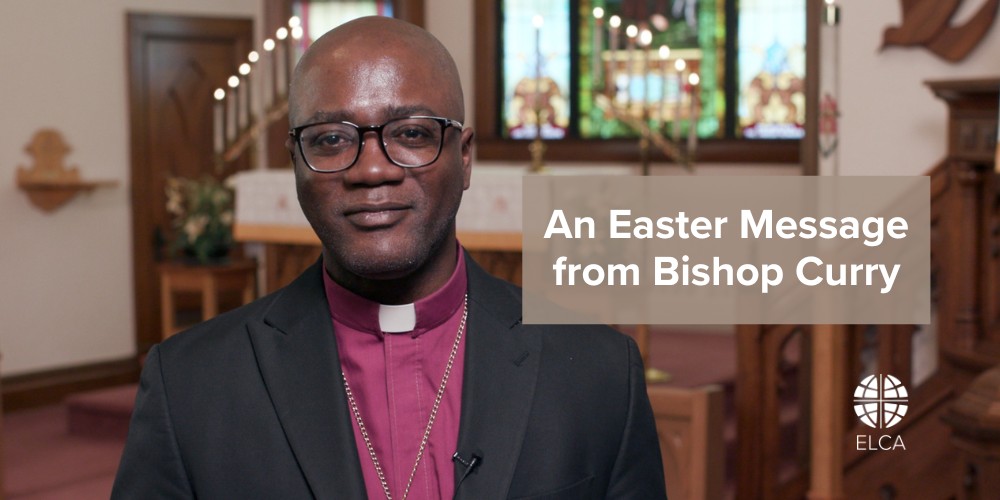
Video
In his Easter message, Bishop Curry reminds us that amid uncertainty comes God’s promise of reassurance and hope.
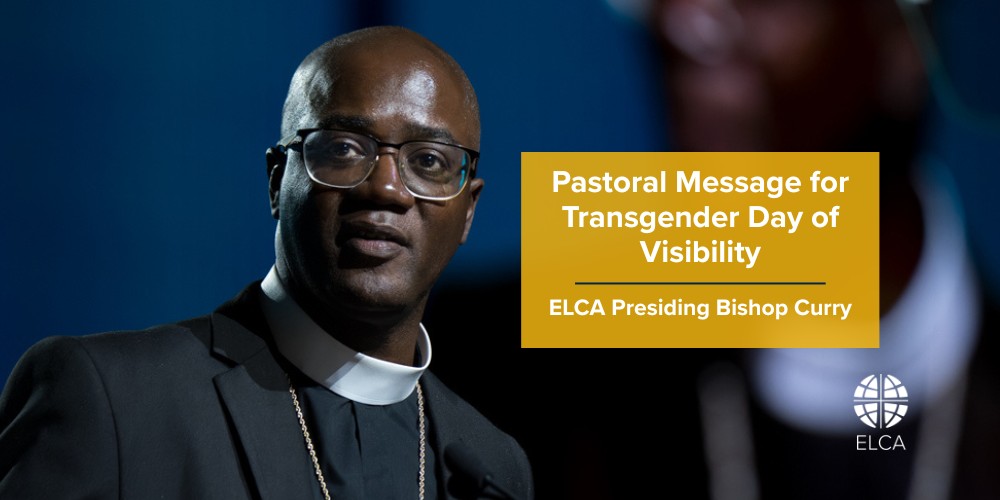
Statement
March 31 is International Transgender Day of Visibility, dedicated to celebrating the lives, gifts and contributions of transgender people.

Event
Based on Ephesians 3:20, the triennial event will be in Minneapolis from June 28-July 2, with pre-events MYLE and the tAble on June 26-28.

Statement
"This church stands with you to say that all forms of sexual and gender-based violence are wrong,” Bishop Curry said to survivors.

Event
Register now: All ELCA deacons, pastors, bishops and candidates approved for call are invited to gather under the theme “Woven Together."

Publication
Meet David Rutlen, a cardiologist, an emeritus professor, a marathon runner and a member of St. James Lutheran Church in Portland, Ore.
Get Involved

Explore Deeper Into Our Church
The Rev. Yehiel Curry is the presiding bishop. Previously, he served as bishop of the ELCA Metro Chicago Synod. He has chaired the ELCA Conference of Bishops, fostering ecumenical relationships and theological engagement across the Lutheran communion. He and his wife, LaShonda, have three daughters.
We believe that all people are imperfect and are saved by God’s grace alone, through Christ. We believe that through the life, death and resurrection of Jesus Christ, God became one of us and took upon himself the sin and suffering of the world.
ELCA social statements are teaching and policy documents that provide broad frameworks to assist us in thinking about social issues in the context of faith and life. They are meant to help communities and individuals with moral formation, discernment and thoughtful engagement with current social issues.
Give Hope. Take Action. Share Faith.

Your gifts to the ELCA support and sustain the people, congregations, synods and ministries working around the world to realize the hope-filled future God promises.
Our “Exploring Church” website can guide you along your faith journey if you are beginning it or have basic questions.
Whether immigrants, LGBTQ individuals, or others marginalized by governmental decisions, you can support them with your voice.
Discover the many ways where the ELCA helps our youth and families grow in faith and build friendships that last lifetimes.
The ELCA works beyond the US. Our work touches the lives of people globally, caring for creations, ministering to those who seek God, and providing relief where it’s needed.
Explore & Stay Connected



Resources

Considering a vocation in the church or a vocation change? Learn more about ELCA seminaries and colleges along with our discernment tool and app, Journi, to start your leadership journey.

Planning worship for your congregation or group gathering? We offer resources to help you plan worship, including the common lectionary, church year reference points, and observances.

Looking for news releases, stories and newsletters? Our News and Stories section offers the latest ELCA news releases and links to newsletters, publications, blogs and videos.
FAQs
All people seek meaning. This can come in the form of knowledge, relationships, spirituality or organized religion. The ELCA is part of the Christian church. We believe God’s grace and unfathomable love are available to all people as a gift through Jesus Christ. All are welcome here with their whole selves, which include one’s race, ethnic background, past wrongdoing, socioeconomic status, gender identity, sexual orientation, physical ability and legal status. Questions and doubts are welcome.
Martin Luther, after whom the Lutheran branch of Christianity is named, wrote, “Faith is a living, daring confidence in God’s grace, so sure and certain that you could stake your life on it one thousand times. … Through faith, a person will do good to everyone without coercion, willingly and happily; serving everyone, suffering everything for the love and praise of God, who has shown such grace.” Faith is about living in a trusting relationship with God in response to God’s grace.
People who identify as Lutherans are those who actively practice their faith in the Lutheran tradition or who have joined a Lutheran congregation through membership. Becoming a member is a way of expressing one’s long-term commitment to the life and work of the church. It also expresses a commitment of resources to sustain the work of the congregation, as well as the national and global church.
All types of people and families are welcome! You are welcome as you are! The ELCA teaches that it doesn’t matter what your experience with religion has been or what kind of doubts or questions you might have about faith. We strive to be a church that celebrates diversity and welcomes all people as they are to worship, learn, serve and grow in faith with others.
All are welcome here. We are a deeply rooted church that is always being made new. Our roots are in Scripture and a collection of writings called the Book of Concord, as well as in the rich histories of our congregations. We strive to be faithful to the gospel and to work toward more justice and wholeness in the world. We are equipped to live and serve in the world with all its complexities, tensions and ambiguities.