

From a fallow field to a wildflower garden - First Presbyterian Church
If you were to walk past the First Presbyterian Church of Chicago (“First Church”) five years ago, you might have thought it a hollow reminder of a once-thriving church. There were holes in the sanctuary’s stained-glass windows, an adjacent lawn was overgrown and dotted with dried-up flowers, and the enormous building was empty just about every day of the week. But when the Rev. David Black first came to First Church in 2020, he saw potential waiting to be tapped. Pastor Black was coming to the South Side of Chicago from New York City, where he had been on staff at Judson Memorial Church in Manhattan. Judson had been transformed into a vibrant arts hub, serving artists of every medium and inspiration. “In churches, I usually saw high institutional art,” Pastor Black says. “Judson embraced those at the fringe. … It illuminated how embracing the fullness of artists does so much for our theological imagination.”
Artists are natural partners for congregations with excess space. Not only do they have the imagination and resourcefulness to use buildings in a different way, they are often in need of local, affordable space in which to create, rehearse, exhibit and perform. Churches often have the kinds of spaces that artists need, though congregations may not immediately think of that possibility. First Church had three floors of unused classrooms and offices, four performance spaces, a gymnasium and a commercial-grade kitchen. Many people saw these underutilized rooms as a sad reminder of the church’s past, but Pastor Black and members of the congregation saw an opening to do what Judson had done — become a home for artists.
It didn’t take long for the Spirit to affirm Pastor Black’s vision. One warm day in 2021, an interdisciplinary artist named Max Li decided to bike to a cemetery on the South Side, and his route took him by First Church. He was struck by the church’s gothic-style architecture and had stopped to take photographs when Pastor Black emerged. “He immediately invited me for a tour of the building,” says Li.
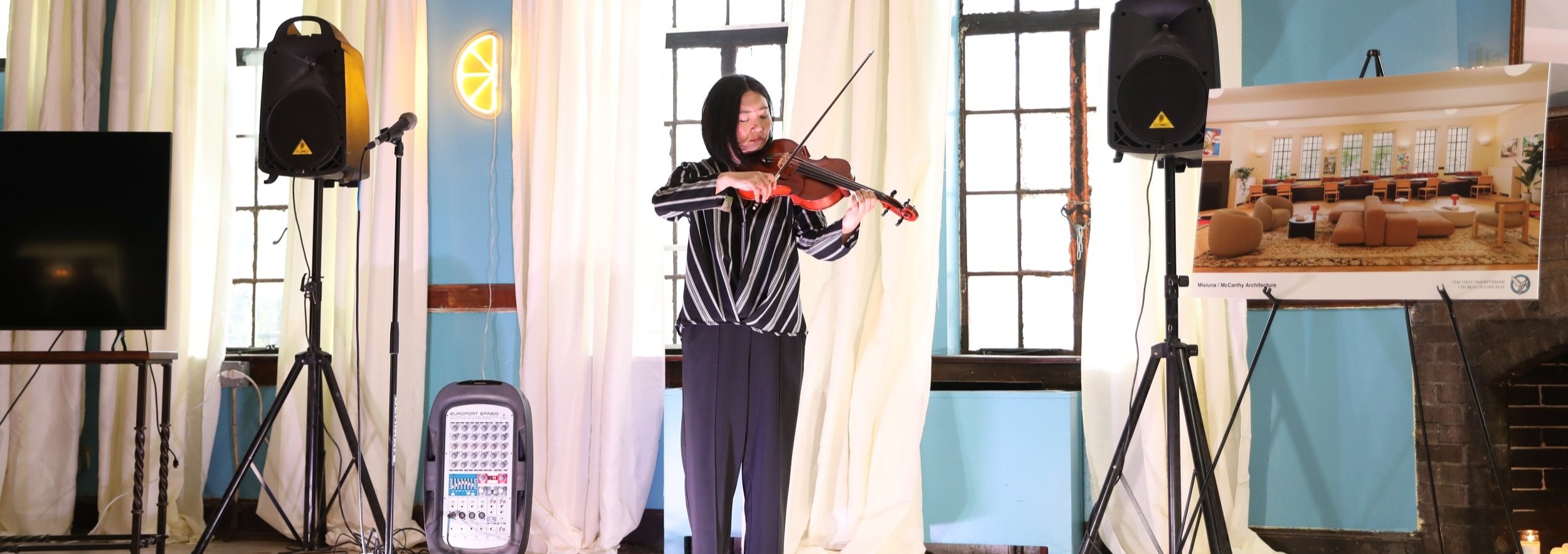
As Li walked through the halls, he was dumbstruck by the number and quality of spaces. He happened to be in the market for a low-cost studio and soon became the church’s first artist in residence. “The church was in great shape,” says Li. “It was just frozen.” He began bringing in friends and other artists as subjects for a tintype photography project and would give each of them a tour of the facilities. They were similarly awestruck, and over several months, artists of many disciplines began activating the spaces in the building — from dance classes to oil painting to concerts.
.JPG)
First Church is now a bustling building, alive with volunteers, artists and community programs seven days a week. In addition to individual artists, the church is home to two weekly feeding programs, an arts nonprofit serving differently abled adults, and a food entrepreneur who manages the kitchen. The majority of these users found the church through their relationships with Pastor Black and Li, through other artists and through word of mouth. In April 2025, the church was a venue for EXPO CHICAGO, and more than a thousand visitors came through the doors for curated openings, fashion shows, house music concerts and other events that breathed creative life into the building. Chicago’s public radio station and local news outlets are excited to share First Church’s story as an example of how churches and artists can create mutually beneficial partnerships.
The church’s relationships with artists and local community groups have created an economy of reciprocity, expanding not just the church’s missional reach but also the capacity of its partners. Artists are inherently collaborative and often trade their skills and connect their friends. One artist, who designs and creates clothing, helped repair one of the church’s torn stage curtains. Chef Dozzy, who manages the kitchen, collaborated with church members and the local food distribution group to create a “Sunday Rice” community dinner once a month. Li and other artists create art for worship services and hold classes for church members. First Church is collaborating with some of its partners to write a grant that will help restore the community greenhouse on its lot.
For Pastor Black, the contrast between the church now and when he first arrived is stark. He describes the church of 2020 as a “fallow field.” “Five percent of the building was used 5% of the week by 26 members who had been through a rough decade,” he says. “There were no policies, no manuals. The church had a name, but the institution had died. All this growth has been from that death.” He sees the death of the institution creating the possibility for new life, just as dying plants regenerate the soil. “We just started planting a garden with the artists, and now we’re seeing what thrives in this community.”
.JPG)
The artists and building are definitely thriving, and the congregation is being transformed, thanks to the church’s new life as an arts hub. As with the artists, First Church is becoming new by attracting less traditional members. “In Sunday worship, we get some visitors who are lifelong Presbyterians, but they often disappear. We also get people who have never been to church in their lives. … They’re here to be tourists, or they’re here to be ironic. But they keep coming back, and they join the church.” Like wildflower seeds being blown on the wind, folks of all backgrounds are finding a home in the building, and the church is blooming with a diversity of possibilities.
Max Li offers a different metaphor to describe his experience of First Church’s transformation. “There’s a proverb in which an emperor asks four blind sages to tell him what an elephant is — they can only describe it in parts.” Li sees the artists, the congregation and the other building users bringing their specific visions to the church. “When we stay within our own disciplines, we can only understand what is in front of us. We need each other to see the bigger picture.”
Li’s part of that vision has made him an advocate for church-artist partnerships. He is now the “arts czar” of First Church and the primary cultivator of partnerships in the building. Though few of the building users, including Li, identify as Christian or attend Sunday service, they see themselves as part of larger church community and are inspired by their own piece of a larger vision.
As First Church’s profile continues to grow in Chicago, Pastor Black and Max Li are often asked for advice from other congregations seeking new life and transformation for their old, empty buildings. Pastor Black tells them to release their grip on their past selves — to let go and let God. “God has a plan for churches right now,” Pastor Black says. “We’re not really in control. The church isn’t ours, and it never was.” Pastor Black hopes that more congregations will lean into their discomfort about sharing space and embrace the imagination of artists, just as First Church has.
Property Stewardship Lessons
- Engage artists as space-users, community connectors and vision partners.
- Think creatively about who can be a “member” of your church or call your building home.
- Pay attention to the Spirit! Follow the imagination of the congregation and your neighbors.